This year marks my 28th year in the Learning and Development space, I’ve moved from Learning support, to facilitating to consultative selling, where I’ve spent the last 16 years meeting and planning training projects with clients. Many in the corporate enterprise space, some in small and medium-sized entities.
“We need training.” They say.
And, to be fair, sometimes they do.
But sometimes training is the corporate equivalent of putting a plaster on a broken arm.
It looks like we’re doing something. There is a course. There are delegates. There are attendance registers. There may even be certificates.
And six weeks later, the original problem is still sitting at its desk, drinking coffee and wondering what happened.
This is where a more focused conversation must happen to determine if Training is the Actual Answer!
So rather than asking, “What training do these people need?”
We should be asking, “What is causing this problem, and will training actually fix it?”
Here’s the thing. Not every workplace or performance problem is a skills problem.
Research and industry thinking have been pointing in this direction for some time.
Harvard Business Review has argued that organisations often reach for training when the underlying problem is actually related to leadership, systems, expectations, accountability or the working environment.
The Greater Training Industry makes a similar point: before recommending training, organisations should identify the performance gap and investigate what is causing it.
The cause could be knowledge or skills, but it could also be tools, processes, capacity, motivation or feedback.
The CIPD found that although addressing skills gaps remains a major priority for L&D professionals, there is still a gap between focusing on learning activity and focusing on measurable performance outcomes.
In other words: Training should be a solution to a diagnosed problem, not the diagnosis itself.
So, how do you decide what route to follow?
Here are a few steps to consider:
- What performance / problem are we trying to improve?
- Use a “Should we train decision tree” to determine the best route to follow.
- If you’ve decided training is the solution, then make sure the workplace supports the process.
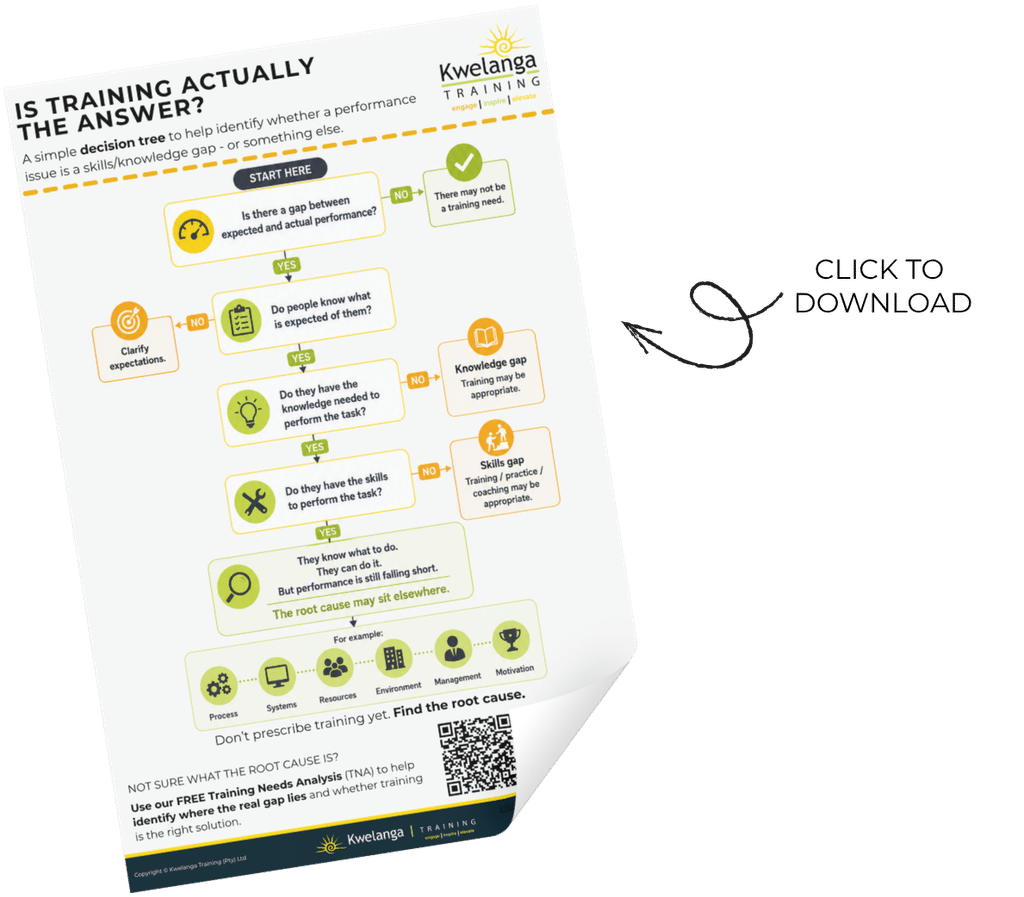
On the last point here, too often I see that whilst all the planning and preparation have been done to deliver a perfect learning experience. Attendees return to the workplace and soon find themselves in the same rut they were in before. Training should not be seen as an event that will affect change immediately. There is a laundry list of post event commitment that must be implemented to ensure learning translates to behaviour change. But that’s a topic for another day or article.
So, what am I trying to say? Yes, training is often the solution to many problems and performance issues, but let’s take the time to determine whether it is in fact the solution by asking questions like:
- “What are you trying to improve?”
- “What is happening now?”
- “What should be happening?”
- “Why is there a gap?”
And lastly:
“What is the most appropriate way to close it?”
Sometimes the answer will be training.
Sometimes it will be coaching.
Sometimes it will be better processes.
Sometimes it will be clearer accountability.
Sometimes it will be technology.
And occasionally, the uncomfortable answer will be that the person simply isn’t suited to the role.
That’s not a training problem either.
The best learning intervention doesn’t start with a course. It starts with understanding the problem you’re trying to solve.
If you’re not sure whether training is actually the answer, or you’re trying to understand what might be driving a performance gap, reach out to me. I’m always happy to have a conversation, ask the right questions and help you work through the best way forward.
Because sometimes, the best solution starts with a conversation – not a course.

By Daniël Steyn, Integrator at Kwelanga Training
Better Learning. Transformed by Human Interaction.
By Daniël Steyn, Integrator at Kwelanga Training