For many organisations, the challenge is no longer whether AI has potential. It is knowing where to start and how to use it purposefully.
AI is changing how we work, but its greatest opportunity in Learning & Development may not be creating training faster. It may be helping organisations build capability in ways that are more relevant, responsive and human-centred.
Artificial intelligence is no longer a conversation reserved for technology teams. Across organisations, people are using AI to create content, analyse information, automate tasks and explore new ways of working.
For Learning & Development professionals, this creates an important question: What does AI actually mean for the future of learning?
The answer goes beyond using AI to create training materials more quickly. The more significant opportunity is to rethink how organisations identify capability needs, personalise development, support the application of learning and connect development to business performance.
But realising that opportunity requires more than adopting new technology. It requires a clear understanding of what people need to learn, how they learn effectively and where AI can make a meaningful difference.
From creating content to creating capability
One of the most visible applications of AI in L&D is content creation. AI can help generate learning materials, develop assessments, adapt content for different audiences and accelerate aspects of learning design.
That is valuable. But it is only part of the opportunity.
The more important question is not simply, How can AI help us create learning faster? It is, How can AI help us make learning more relevant, responsive and effective?
This shifts the conversation from training delivery to capability development.
AI can support the adaptation of learning content, the development of role-specific learning experiences and the exploration of different ways to practise new skills. It can also help L&D teams organise information and identify opportunities to improve existing learning approaches.
However, these capabilities are most valuable when they address a clearly identified need.
Producing more content does not automatically mean people are learning more effectively. A well-designed learning experience must still connect to the challenges employees face, the capabilities the organisation needs and the outcomes it wants to achieve.
The opportunity is not simply to produce more learning. It is to create better learning experiences that are more closely connected to what people and organisations actually need.
AI adoption starts with people
For organisations to benefit from AI, employees need more than access to technology. They need the knowledge, confidence and practical skills to use it effectively.
PwC’s Global Workforce Hopes and Fears Survey 2025, which surveyed nearly 50,000 workers across 48 major economies, found that 54% of respondents had used AI for work in the previous 12 months. Only 14% reported using generative AI daily at work.
These findings illustrate the difference between having access to AI and incorporating it into everyday working practices.
For L&D teams, this presents an important consideration: how can organisations ensure that employees have access to relevant learning and development as AI becomes increasingly embedded in the workplace?
A broad introduction to AI may provide a useful starting point, but employees will also need opportunities to explore how the technology relates to their responsibilities.
A sales professional, a finance practitioner and a first-line manager will encounter different opportunities and challenges when applying AI. Their learning needs will reflect their roles, tasks and working environments.
This makes contextualisation and role-specific development increasingly important. Rather than focusing solely on general AI awareness, organisations can explore how learning might help employees apply AI to relevant workplace situations.
The aim is to build capability that people can use, not simply knowledge of what the technology can do.
The human element becomes more important, not less
As AI becomes more capable, it is natural to question how much of the learning experience should be automated.
AI can generate content, analyse information, support personalisation and automate certain tasks. But meaningful learning also involves conversation, reflection, challenge, practice, feedback and relationships.
These elements are particularly important when developing business and people skills such as communication, leadership, collaboration and problem-solving.
People need opportunities to test their understanding, learn from different perspectives and apply new skills to situations that may be complex or unpredictable. They also need feedback and support as they translate knowledge into workplace behaviour.
AI can complement these experiences, but it should not be mistaken for the entire learning journey.
Leadership is another important part of this picture. PwC’s workforce research found that 58% of employees surveyed trusted their direct manager and felt able to speak openly with them.
As AI changes how work is performed, managers have an important role in helping employees understand those changes, ask questions, build confidence and navigate new expectations.
For L&D, this creates an opportunity to support not only technical AI capability, but also the leadership and people skills needed to guide teams through change.
At Kwelanga Training, we believe learning is more than an event or the transfer of information. It is a journey shaped by experience, interaction and application.
As AI becomes part of that journey, the question should not be whether we choose AI or human interaction.
It should be how we bring the two together to create better learning.
Moving from experimentation to strategy
For many organisations, the challenge is no longer whether AI has potential. It is knowing where to start and how to use it purposefully.
Where can AI genuinely improve the learning experience? What capabilities will employees need? How should organisations approach responsible use? And how will they know whether their investment is making a meaningful difference?
Introducing AI without a clear purpose can create more activity without necessarily improving outcomes.
An AI-ready L&D strategy should begin with the learning or business challenge, not the technology.
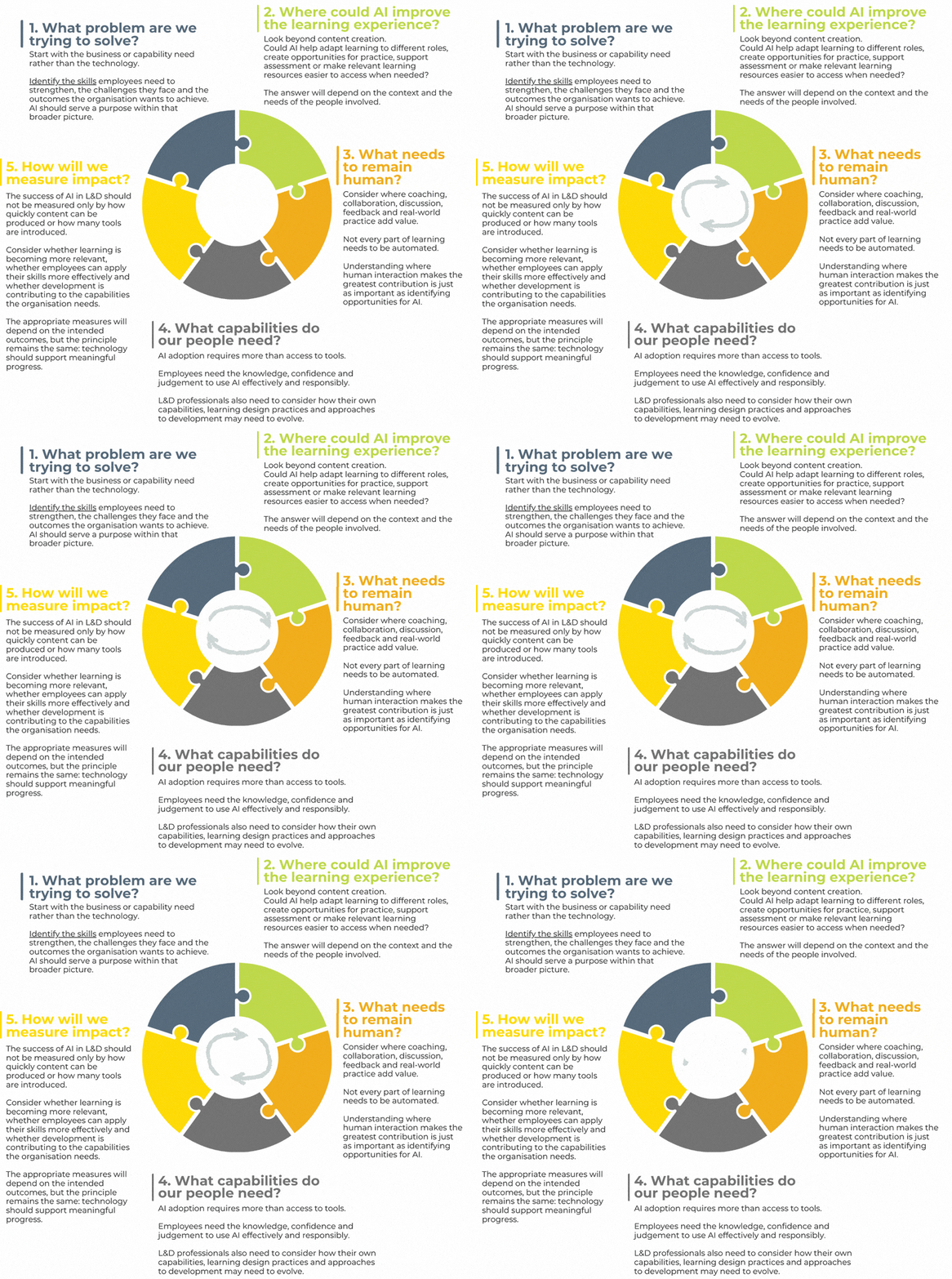
Five questions can help organisations approach that challenge more thoughtfully.
The next chapter of L&D won’t be about technology alone
AI is undoubtedly changing the L&D landscape. But perhaps the most important shift is not technological. It is a shift in how we think about learning itself.
The opportunity is to move towards learning that is more personalised, practical, responsive and connected to the realities of work.
AI can help make that possible. But technology alone cannot create a learning culture, build trust or ensure that people apply what they learn.
Those outcomes require thoughtful design, relevant development, supportive leadership and meaningful human interaction.
The organisations that benefit from AI in L&D will need to understand where technology can add value, where people make the greatest difference and how the two can work together.
The question isn’t whether AI will change L&D. It’s what we choose to change with it.
Missed our recent webinar?
Smarter Learning, Stronger Talent: Unlocking AI’s Potential in L&D
View the recording below:
Better Learning. Transformed by Human Interaction.
What does AI actually mean for the future of learning?